The decision to purchase or sell a home often comes down to more than finding the right property or choosing the right time to list. Financing costs, property values, and overall market conditions can have a significant influence on what makes financial sense.
As 2027 approaches, many prospective buyers and homeowners are evaluating whether the coming year might offer better opportunities.
Recent projections from major housing and financial institutions suggest that the market could experience a period of relative stability. Rather than dramatic changes in borrowing costs or property values, economists anticipate more moderate conditions that may help buyers and sellers make decisions with greater confidence.
Understanding these expectations can provide a useful starting point for planning your next real estate move.
Mortgage Rates May Remain Relatively Consistent
Mortgage rates continue to play a central role in housing affordability. Even modest changes can influence monthly payments, purchasing power, and the overall cost of homeownership.
For those hoping to see a substantial decline in borrowing costs, the current outlook suggests that patience alone may not deliver the results they expect.
Projections published by Fannie Mae, the Mortgage Bankers Association, and Wells Fargo indicate that mortgage rates could remain within a relatively narrow range throughout 2027.
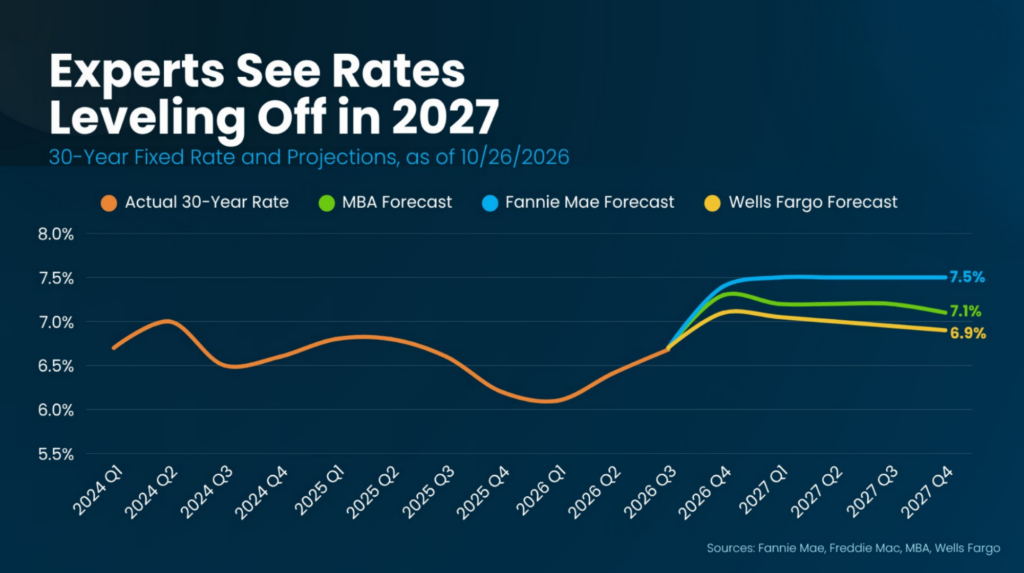
Expectations within the lending industry also reflect a cautious outlook.
According to a HousingWire survey, 70% of mortgage executives anticipate rates reaching approximately 7.5% or higher within the next six months.

These projections highlight the uncertainty surrounding future borrowing costs. Mortgage rates respond to numerous economic influences, including inflation, bond market activity, employment conditions, and broader financial developments.
Chen Zhao, Head of Economics Research at Redfin, explains:
“Until the underlying economic fundamentals—everything from oil prices to AI–that are keeping rates high change, mortgage rates are unlikely to fall significantly.”
What Buyers Can Do Instead of Waiting
While market conditions are outside an individual buyer’s control, several financing decisions can make a meaningful difference in affordability.
Strengthen your credit profile. A higher credit score may help you qualify for more competitive financing terms. Reviewing your credit history and addressing outstanding issues before applying for a mortgage can be worthwhile.
Compare available mortgage programs. Conventional, FHA, VA, and other eligible financing options have different qualification requirements and cost structures. Evaluating multiple programs can help identify the most appropriate fit.
Evaluate mortgage discount points. Some lenders allow borrowers to pay additional costs at closing in exchange for a lower interest rate. Whether this makes financial sense depends on how long you expect to keep the mortgage and how much you could save over time.
Request estimates from multiple lenders. Comparing interest rates, closing costs, and loan terms can reveal differences that might not be obvious from an advertised rate alone.
The objective is not necessarily to secure the lowest possible interest rate in the market. It is to understand your financing options and determine whether the resulting payment supports your financial priorities.
Home Values Are Expected to Experience Modest Growth
Mortgage rates are only one part of the affordability equation. The direction of home prices also affects how much buyers need to finance and how much equity homeowners may accumulate.
Current national forecasts suggest that residential property values will continue to appreciate through 2027, although at a slower pace than during periods of rapid market expansion.
Estimates from Fannie Mae, the Mortgage Bankers Association, and Wells Fargo point toward annual home price growth averaging approximately 1% to 1.5%.

This anticipated moderation could create a different environment for both sides of a real estate transaction.
How Slower Appreciation Could Affect Buyers
When property values rise more gradually, buyers may have additional time to evaluate their options without facing the same pace of price increases experienced in faster moving markets.
Depending on local inventory and demand, buyers may also encounter opportunities to negotiate on purchase prices, closing costs, or other contract terms.
However, slower appreciation does not necessarily mean homes will become less expensive. A property that increases in value by a modest percentage is still becoming more costly, even if the rate of growth has slowed.
For buyers considering a purchase, affordability should be evaluated using current financing costs, available inventory, and long term ownership plans rather than relying entirely on the possibility of future price reductions.
What the Forecast Means for Homeowners and Sellers
For existing homeowners, continued appreciation could support gradual equity growth, although individual property values may perform differently.
Sellers, meanwhile, may need to adjust their expectations to reflect a market where buyers have more time to compare properties and assess value.
Accurate pricing, thoughtful preparation, and a strong marketing strategy remain important, particularly when competing homes offer similar features or amenities.
A property priced appropriately for its location, condition, and current demand may be better positioned to attract serious interest than one priced primarily around past market performance.
Why Local Housing Conditions Matter More Than National Averages
National forecasts are valuable for understanding broader economic trends, but they cannot fully describe what is happening within an individual city or neighborhood.
North Texas is a good example of why local analysis matters.
Housing conditions across McKinney, Frisco, Prosper, Celina, and surrounding communities can vary based on available inventory, new construction activity, neighborhood demand, and property characteristics.
Even within the same city, homes in different price ranges may experience very different levels of buyer interest.
For example, a neighborhood with limited available inventory may maintain stronger pricing than an area where buyers can choose among numerous comparable properties.
This is why national projections should serve as context rather than a substitute for current local market data.
Before making a purchase or listing decision, it is important to review recent comparable sales, active competition, pricing trends, and the amount of time similar properties are spending on the market.
Should You Buy or Sell Before 2027?
A market forecast can help inform your plans, but it should not be the only factor determining when you move.
For buyers, the more relevant questions may involve financial readiness, available housing options, and whether the monthly cost of ownership fits comfortably within their budget.
For sellers, timing may depend on current equity, the condition of the property, the availability of a replacement home, and personal circumstances.
Waiting for a major shift in mortgage rates or home prices carries uncertainty. Forecasts can change as economic conditions evolve, and the most favorable opportunity for one household may not be the right choice for another.
Rather than trying to identify the perfect market moment, consider how a move would support your needs today and over the coming years.
Final Thoughts
The outlook for 2027 points toward a housing market characterized by relatively stable mortgage rates and gradual home price appreciation. While these expectations do not guarantee future results, they offer a useful framework for buyers and sellers evaluating their options.
For anyone considering a move in North Texas, understanding neighborhood level conditions is just as important as following national predictions.
Whether you are preparing to purchase your next home, considering selling, or simply exploring your possibilities, a personalized review of current market conditions can help you make a more informed decision.
Thinking about buying or selling in North Texas? Connect with Vesta Schneider to discuss local market trends, evaluate your options, and develop a real estate strategy aligned with your goals.
Selling Soon | Vesta Schneider Real Estate
Looking For a New Home | Vesta Schneider Real Estate